

Material Issues

SANKYO Group’s Sustainability Priority Issues (Material Issues)
As a leading manufacturer in the pachinko and pachislot machine industry, along with its affiliated companies, the Group is committed to the mission of “creating innovative products through originality and ingenuity.” This mission is built on a management foundation rooted in ESG principles. By addressing the five identified key sustainability issues (material issues), we aim to create innovative products supported by a stronger management foundation, thereby maximizing corporate value through the simultaneous creation of both economic and social value.

- Creation of high value-added products
- Organizations and systems that enable innovations
- Responsibility for safety and reliability of products

- Respect for diversity and human rights
- Investment in human resource development
- Creating a workplace that makes work rewarding

- Initiatives to address climate change
- Effective use of resources

- Initiatives to prevent addiction among end users

- Promotion of corporate governance that adapts to social demands

Process for Identifying Material Issues
Material issues were identified through a process of internal discussions and dialogues with external experts, led by the Sustainability Committee and involving the management team. During this process, we particularly emphasized the following points.
1. Corporate Motto, Management Philosophy
2. Identifying corporate issues from a long-term perspective
3. Considering opinions and requests related to environmental and social issues from stakeholders
■Specific Steps
STEP1
Identifying Long-Term Issues
Based on the perspective of our long-term corporate activities, we comprehensively identified a wide range of issues related to the environment, society, and the pachinko and pachislot machine industry.
STEP2
Communication with Stakeholders
We enhanced the accuracy of our information and scrutinized potential issues through active communication with institutional investors and external experts.
STEP3
Mapping of Issues Identified and Scrutinized
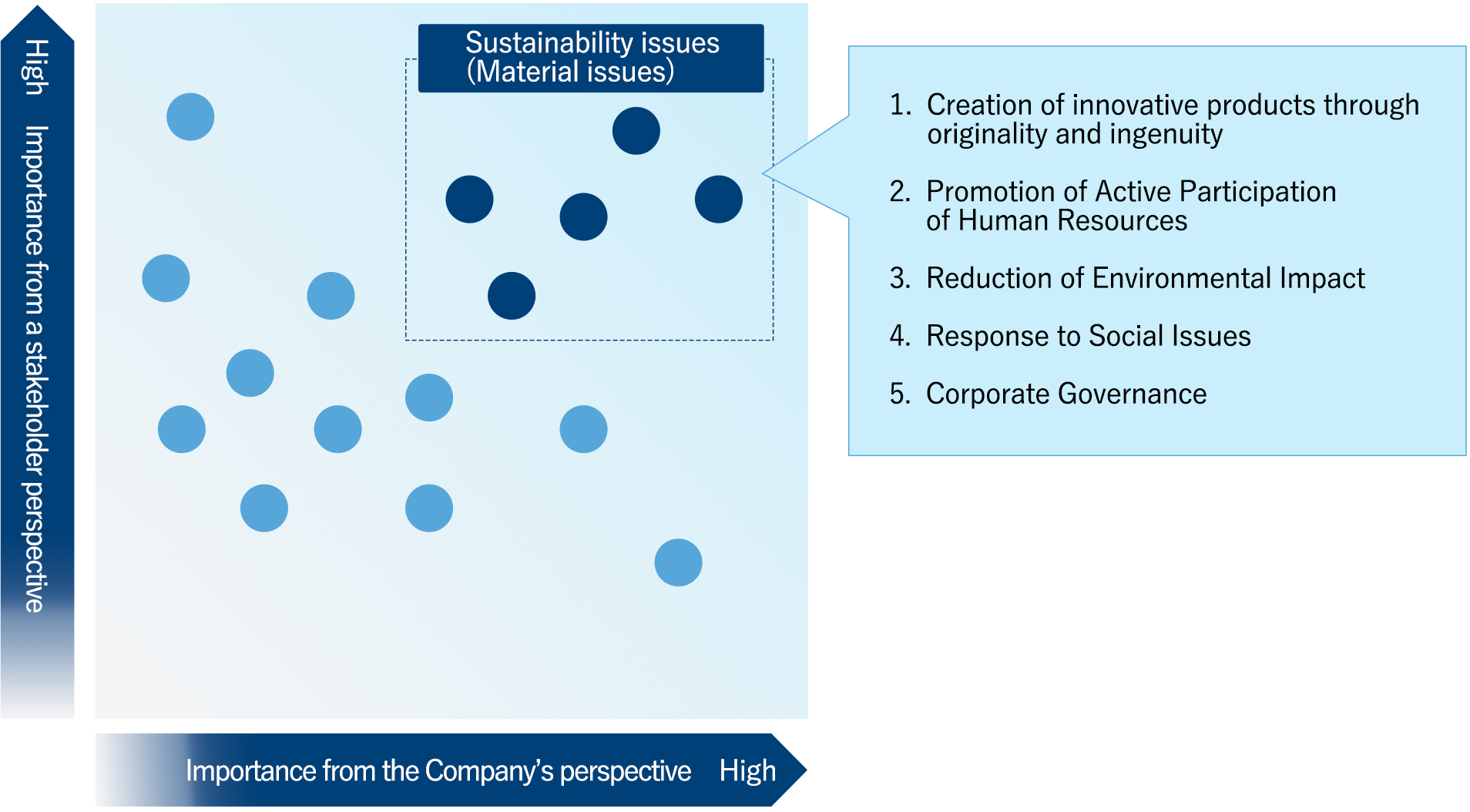
We determined the key points for consideration in the identified and scrutinized candidate issues, mapping them from both stakeholder and corporate perspectives based on these key points.
STEP4
Discussion by Management
The mapped candidate issues were discussed by the Sustainability Committee, chaired by the Representative Director, President and attended by the general managers of each division.
STEP5
Identification of Material Issues
Issues prioritized for discussion and decision were identified as materialities, and these decisions were subsequently reported to the Board of Directors following approval by the Sustainability Committee.
Based on these internal discussions, including those involving the management, as well as input from a range of stakeholders—including institutional and individual investors, shareholders, customers, and local residents—we mapped out potential issues. This mapping was based on evaluating the importance of these issues from both our own perspective and that of our stakeholders.
As a result, we identified five key sustainability issues (material issues) that we have prioritized for action.
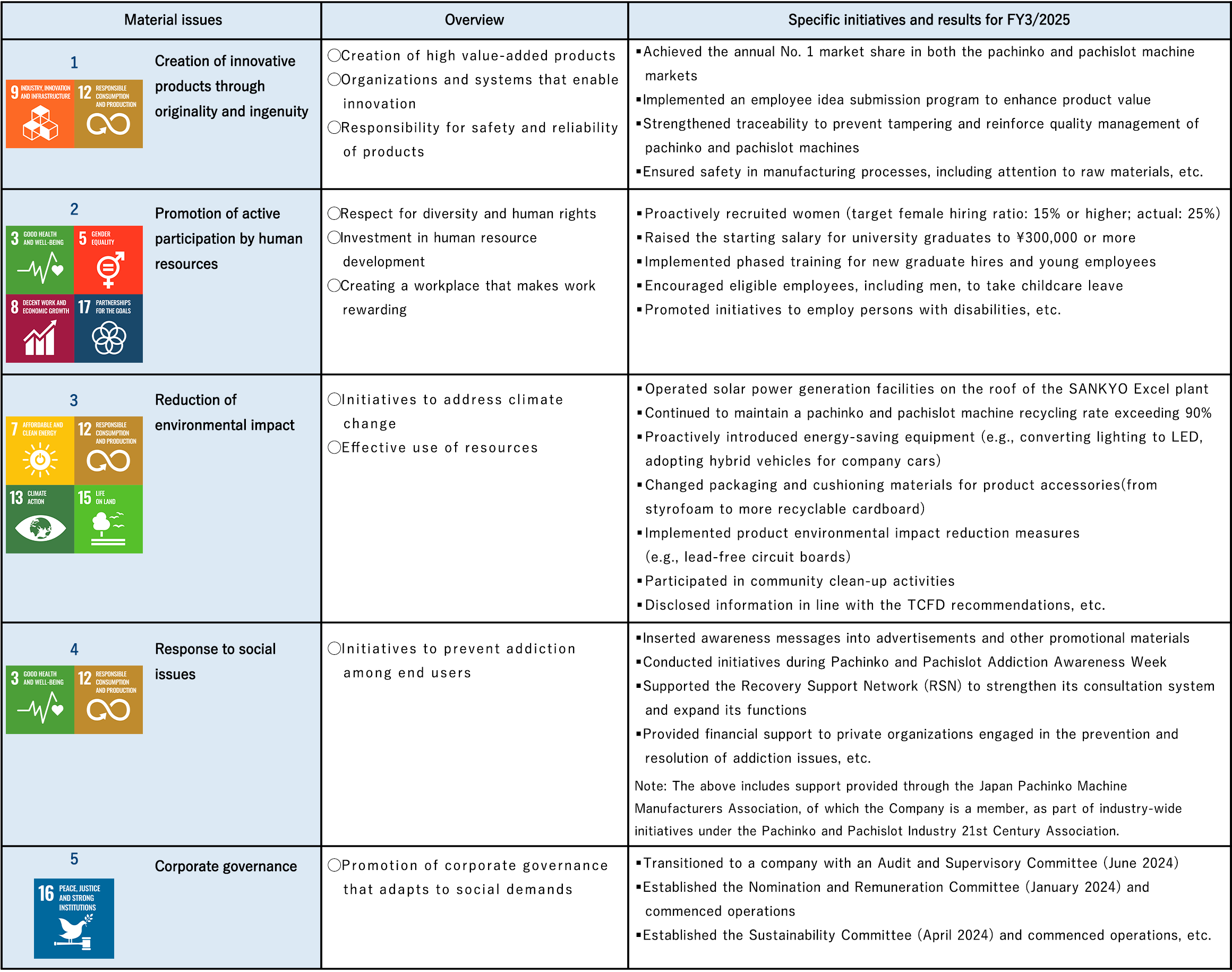
Status of Material Issues Initiatives
ESG Evaluations by External Institutions
Selected as a Constituent of the FTSE JPX Blossom Japan Sector Relative Index (From June 2025)The FTSE JPX Blossom Japan Sector Relative Index, to which we were newly added, is constructed by FTSE Russell of the United Kingdom, a global index provider. The index includes Japanese companies within each sector that demonstrate relatively advanced initiatives in environmental, social, and governance (ESG) practices. In addition, among companies with higher greenhouse gas emissions, only those assessed as improving based on the TPI Management Quality Score are included, thereby supporting the transition to a low-carbon economy.

FTSE Russell confirms that SANKYO CO., LTD. has been independently assessed according to the index criteria, and has satisfied the requirements to become a constituent of the FTSE JPX Blossom Japan Sector Relative Index. The FTSE JPX Blossom Japan Sector Relative Index is used by a wide variety of market participants to create and assess responsible investment funds and other products.
